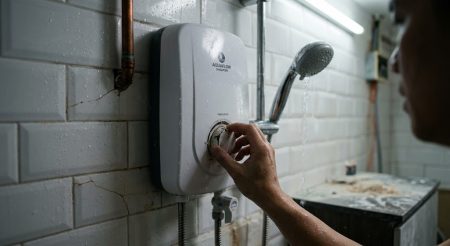



Every morning millions of us step into the bathroom and turn a brass valve expecting an immediate flood of warm water. We treat this daily ritual as a quiet certainty, rarely questioning the hidden machinery concealed behind the damp wall tiles. Yet behind that porcelain surface lies a relentless battle between water pressure and raw electrical current.
When a heating unit begins to fail, the breakdown rarely happens all at once. Small changes in temperature and water pressure serve as early clues that your household plumbing is under severe mechanical strain. If you are examining your bathroom setup and looking for an instant water heater singapore replacement, understanding how electrical resistance actually interacts with water flow will prevent a costly disaster inside your walls.
The Mechanical Physics Of Flow Restriction
An instant heating unit does not rely on a large pre-heated tank hidden in a cupboard. Instead, it forces cold tap water through a narrow copper canister containing a glowing electrical element. To raise the temperature of that water instantly, the machine must physically restrict how fast the liquid moves past the heating coil.
This introduces a fundamental trade-off that many homeowners overlook when upgrading their bathrooms. If you open the tap fully during a cooler spell, the water rushes past the copper element too quickly to absorb sufficient heat energy. By turning the main inlet valve down by a quarter turn, you reduce the volume of water entering the unit, giving the element the crucial seconds it needs to heat the stream thoroughly.
The Fire Hazard Hidden In Thin Wires
A common and dangerous mistake made during bathroom renovations is attaching a powerful modern heating box to older electrical wiring. Homeowners often assume that if a wire previously powered an appliance, it can handle a newer, higher-wattage model.
High-capacity instant units draw a massive current, often exceeding 3,300 watts the moment the water flows. If your wall contains thin 2.5-millimetre cabling rather than a dedicated 4.0-millimetre circuit pulled directly from the consumer board, the electrical resistance generates intense heat behind your tiles. Over time, this hidden heat degrades the plastic insulation, creating a severe fire hazard inside your walls.
Calculating Thermal Output Against Water Volume
To understand how your home heating setup behaves, you must look at the concrete mathematics of energy transfer. A standard 3.3-kilowatt element can only raise a specific volume of water by a fixed number of degrees Celsius every minute.
For example, if cold incoming groundwater sits at 22 degrees Celsius, a 3.3-kilowatt element pushing 4 litres per minute can comfortably deliver water at 38 degrees Celsius. However, if you attach a luxury rain showerhead that demands 8 litres per minute, the exact same power output drops the water temperature down to a lukewarm 30 degrees. The physics of energy transfer cannot be cheated by stylish chrome fixtures.
The Pressure Switch That Demands Attention
Before purchasing any new heating equipment, you need a clear decision rule regarding your home standing water pressure. Every instant unit relies on an internal hydraulic pressure switch to flip the electrical circuit on when water begins flowing.
If your residential water pressure sits below 1.5 bar, the internal switch will fail to engage consistently. You will end up standing under a freezing drizzle as the machine refuses to turn on its element. If your measured standing pressure is under this 1.5-bar threshold, you must install a dedicated booster pump before investing in a new inline heater.
Protecting Copper Heating Coils From Decay
Over months of daily use, microscopic minerals dissolved in raw tap water bake onto the hot copper coil inside the heating chamber. This creates a hard crust of limescale that acts like an insulating blanket around the metal.
As the limescale thickens, heat becomes trapped inside the copper element, forcing it to run at dangerously high internal temperatures until the wire eventually snaps. To extend the life of your equipment, establish a simple maintenance habit:
- Keep the electrical isolator switch turned off when away on holiday.
- Flush cold water through the system for two minutes upon returning.
- Turn the wall switch back on only after the canister is completely full.
Understanding the invisible mechanics of domestic plumbing transforms how you care for your home. When you respect the delicate balance between water volume, electrical capacity, and hydraulic pressure, you eliminate the frustration of unexpected cold showers. Taking time to evaluate your wiring and water pressure ensures that your daily bathroom routine remains a quiet, dependable comfort for years to come.