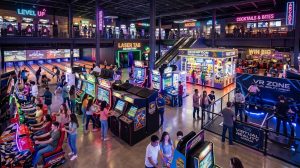



Walk into a complex arcade on a Saturday afternoon and nothing is quiet. Cabinets chirp in attract mode, ticket strips feed out of redemption games, someone at the back is losing a close round on a fighting game, and a birthday party is arriving at the front. A complex arcade is a large entertainment space that puts dozens or even hundreds of machines, a prize counter, food, and group areas under one roof. The same phrase is also used for arcade games that hide real depth behind a simple coin slot. This guide covers both meanings, from how an arcade complex is built to which complex arcade games reward practice, how to spend your credits wisely, and what it takes to run one.
A complex arcade is a multi-zone arcade complex that combines video cabinets, redemption games, racing and motion rides, pinball, dining, and party rooms in one venue. It can also describe an arcade game with layered mechanics, such as a fighting game or rhythm cabinet, that takes practice to master.
What “complex arcade” really means
The phrase turns up in two different conversations, and it helps to separate them early. In the first, a complex arcade is a place: a big, multi-zone venue that people also call an arcade complex, an arcade entertainment complex, a game complex, or a family entertainment center. Video machines share the floor with bowling lanes, a kitchen, party rooms, and a wall of prizes. In the second, complexity is a quality of the game itself. A complex arcade game asks for more than quick reflexes. It might layer scoring rules on top of movement, require you to learn character matchups, reward route planning, or split roles between two or four players.
These meanings overlap more than you might expect. A venue large enough to earn the name complex arcade has to serve a toddler, a competitive teenager, a grandparent, and an office team on the same evening. So it tends to stock a wide spread of complex arcade machines, from easy ticket games that anyone can enjoy in thirty seconds to deep cabinets that people study for years. This article treats both meanings together, because the person planning a visit and the person choosing a game to master are very often the same person.
The venue
A large arcade complex with several zones, a card-based payment system, a prize counter, food and drink, and space for parties and events. Think of it as a small entertainment district with a roof.
The game
A complex arcade game with layered systems, from combo inputs and risk-reward scoring to cooperative roles. It is easy to start and takes real time to master.
How arcades grew into complexes
Coin-operated amusements are older than video games. Penny arcades in the early twentieth century offered mechanical fortune tellers, strength testers, peep-show viewers, and the first pinball tables. When electronic games arrived in the early 1970s, the idea simply moved to a new kind of machine. Pong showed that a screen and a coin slot could draw a crowd, and by the end of the decade Space Invaders had turned arcades into places people planned their evenings around. Pac-Man followed in 1980 and widened the audience further.
The golden age ran on novelty and competition. Every new cabinet was a small event, and the high-score table was a public ranking that anyone could try to climb. Then home consoles got good. By the 1990s, many arcades struggled to explain why anyone should pay per play for something a living room could do. The ones that survived found their answer in what a living room could not copy: scale, physical machines, shared noise, and in-person rivalry. Fighting games like Street Fighter II built tight local scenes. Rhythm cabinets with big pads and light-up arrows turned playing into a performance. Redemption games brought families in, because a handful of tickets and a prize wall make a small win feel real.
From there the arcade complex took shape. Operators realized that a person who stays three hours spends differently from a person who drops by for ten minutes. They added food, bowling, laser tag, party rooms, and comfortable seating. The arcade stopped being a corner of a mall and became the destination. Today the best complex arcade venues feel like a blend of a game hall, a restaurant, and a community room, and the machines inside are as varied as the people who visit.
What is under one roof
No two venues are identical, but most arcade complex layouts group their offerings into recognizable zones. Knowing the zones makes the floor less overwhelming, especially on a first visit.
Video cabinets
Upright and sit-down machines for fighters, shooters, rhythm games, and puzzle titles. This is where most complex arcade games live, and where you will find the longest-running rivalries.
Redemption games
Skee-Ball style lanes, coin pushers, claw machines, and quick-fire target games that pay out tickets. They are easy to learn and fair to compare, which makes them ideal for mixed-age groups.
Racing and motion
Full-size seats, force-feedback wheels, and cabinets that tilt or shake. These are the showpieces that pull people in from the entrance, and they are often linked for head-to-head races.
Pinball and skill
Classic and modern pinball tables, air hockey, foosball, and basketball hoops. Pinball in particular rewards patience, because each table has its own rule sheet and scoring quirks.
Immersive and VR
Headset rooms, motion platforms, and walk-in experiences. They are priced higher per play and usually booked or queued, so they sit apart from the main floor.
Food, parties, prizes
A kitchen or snack bar, private party rooms, and a prize counter near the exit. These areas turn a quick visit into a half-day outing and keep groups together.
Some venues add bowling lanes, mini golf, laser tag, or escape rooms. Those extras are what push an arcade into complex territory in the architectural sense of the word: several attractions linked by shared walkways, shared payment, and a shared sense of place.
Complex arcade games and the pull of depth
Arcade design has always favored clarity. A game has a few seconds to explain itself to a stranger holding a handful of tokens, so menus, inventories, and long tutorials have no place on the floor. Yet the machines people remember for decades are often the deepest ones. The trick is to hide the complexity behind a simple surface. You can grab a stick and press a button in the first minute, and still be discovering new ideas a year later.
Easy to learn, slow to master
The strongest complex arcade games follow one rule: the first ten seconds are obvious, and the next ten hours are not. A fighting game lets a beginner mash buttons and see something happen, while a veteran chains moves into a planned sequence. A rhythm game lets you tap along on the easy setting, then asks for footwork and stamina on the hard one. The depth is optional, which is why one cabinet can hold a crowd of casual players and a handful of obsessives at the same time.
What actually creates complexity
When people call a game complex, they are usually describing one or more of these layers:
- Scoring systems. Multipliers, chains, and risk-reward bonuses that make the highest score very different from simply surviving.
- Execution. Precise timing, directional inputs, and combos that must be performed under pressure.
- Knowledge. Matchups, enemy patterns, hidden rules, and optimal routes that you can only learn by repetition.
- Resource management. Limited lives, ammo, special meters, or power-ups that force a choice about when to spend them.
- Teamwork. Cooperative cabinets where each player has a role, and success depends on communication.
Operators often tune these layers through the machine’s own settings. Difficulty, credits per play, and whether the game runs in free play can all be adjusted, which is why the same title can feel gentle in one venue and brutal in another.
Genres where depth hides
| Genre | Where the complexity lives | A sensible first move |
|---|---|---|
| Fighting games | Character matchups, combos, spacing, and reading an opponent | Pick one character and learn two or three reliable moves |
| Rhythm and dance | Timing accuracy, pattern recognition, and stamina | Start on the lowest difficulty and watch your feet, not the screen |
| Shoot ‘em ups | Bullet patterns, scoring tricks, and positioning | Learn to hug the edges and keep one safe route |
| Racing simulators | Braking points, racing lines, and car setup | Brake earlier than feels natural for the first three laps |
| Pinball | Rule sheets, mode sequences, and ball control | Read the card on the glass before you launch |
| Co-op light-gun | Target priority, reload timing, and splitting the screen | Agree who covers left and who covers right |
Looking for a game that rewards time? Choose the cabinet with a small crowd and a long line of initials on its high-score screen. People rarely keep coming back to something shallow.
Play the genres right here
Reading about depth only goes so far. Each tab below is a pocket version of one genre from the table above, so you can feel what makes these complex arcade games tick. They are small original games rather than copies of licensed cabinets, but the core idea of each genre is intact: reading an opponent, timing a note, threading a bullet pattern, holding a racing line, controlling a ball, or hitting a moving target. Pick a tab, press the button to start, and try to beat your own best score.
Notice how each game hides its depth. The fighting duel is three buttons, yet the winner is the player who stops repeating themselves. That is the same easy-to-learn, slow-to-master design that keeps people returning to the real machines.
Classic and modern machines side by side
Walk the floor of any serious arcade complex and you will see both eras in the same aisle. A cabinet from the 1980s sits a few steps from a modern machine with a wraparound screen and networked leaderboards. Neither is automatically better. They solve different problems, and a good venue keeps both.
| Feature | Classic cabinets | Modern machines |
|---|---|---|
| Controls | A joystick and one to three buttons | Wheels, guns, pads, touch panels, and motion sensors |
| Session length | Short, with a clear game-over point | Often timed, with bonus rounds and unlockables |
| Scores | Local high-score table with three initials | Online rankings and linked head-to-head play |
| Maintenance | Aging parts, hand repair, and sourcing spares | Software updates and sensor calibration |
| Appeal | Nostalgia and pure skill | Spectacle, social play, and progression |
The modern complex arcade machine leans on spectacle and connection. Linked racing seats let eight strangers compete at once, and some cabinets track your progress with a personal card so you can pick up where you left off. The classic cabinet leans on honesty: one stick, one screen, no help. Many visitors end up loving the contrast, moving from a loud immersive ride to a quiet shooter and enjoying the gear change.
How the floor of an arcade complex is designed
The layout of a good complex arcade is not accidental. Operators think about it the way a retail planner thinks about a store, because where a machine sits decides how often it is played.
Sightlines and anchors
Big, bright, loud machines go where they can be seen from the entrance. Racing seats, a giant claw machine, or a flashy dance cabinet act as anchors that tell newcomers the place is alive. Smaller and quieter titles sit deeper, where people who came for them will find them anyway. The prize counter is usually visible from most of the floor, because a wall of prizes is the best advertisement for redemption games.
Sound and light
An arcade is loud by nature, but a well-designed one manages the noise. Rhythm games and racing rides are grouped so their sound does not drown out a delicate pinball table. Lighting is kept dim enough for screens to glow without glare, with brighter pools over seating and the counter so people can read prices and menus. Poor lighting leads to reflections on screens and eyestrain, and a surprising number of complaints come down to that alone. Operators planning a large space often look into specialized fixtures, such as the high-bay lighting discussed in this LED high bay light selection and installation guide, to cover wide ceilings evenly.
Flow and comfort
Aisles need to be wide enough for strollers, wheelchairs, and queues at popular machines. Seating near the action lets parents watch younger children without hovering. Restrooms, a quiet corner, and clear exits matter as much as the machines themselves, since they decide how long a family will stay. Staff should be able to see most of the floor from one or two positions, which makes both service and safety easier.
Playing smarter in a complex arcade
Showing up with a plan turns a noisy blur into a good afternoon. These steps work whether you are visiting a small hall or a sprawling arcade complex with a hundred machines.
- Walk the floor firstSpend five minutes looking before you spend anything. Note which machines have a line, which are broken, and which look like something you would enjoy.
- Read the card and the rulesCheck how credits work, whether a power card carries bonuses, and what each game costs. Prices vary a lot between a ticket lane and a premium ride.
- Set a ceiling before you startDecide the total you are happy to spend, and load that amount and no more. It is easier to hold a limit that exists before the lights and sounds start working on you.
- Warm up on something simpleStart with a game that rewards basic coordination. Hands and eyes need a few minutes to adjust to a new set of controls.
- Learn the scoring, not just the buttonsOn a complex arcade game, the scoring rule is often the whole secret. A few seconds reading the attract mode or the card on the glass can double your result.
- Do the redemption mathIf you are playing for tickets, compare roughly how many tickets a game pays per credit against what you want at the counter. Some games are far better value than others.
- Rotate and restSwitch between loud and calm games, and stop for water. Fatigue is the quickest way to burn credits on poor play.
- Respect the queueIf someone is waiting for a popular cabinet, take one more round and then step aside. The regulars will remember you kindly.
Visit budget planner
Adjust the numbers to get a rough idea of how many plays you will get and what an outing might cost. This is an estimate, since real prices differ between machines and venues.
If you plan outings like this regularly, a simple monthly line for entertainment makes the numbers feel less random. These tips on how to budget and save money effectively show one easy way to set it up.
Visiting with different groups
A complex arcade is one of the few places where a seven-year-old, a seventeen-year-old, and a seventy-year-old can all find something they like. The trick is matching the group to the zone.
Families with younger children
Begin in the redemption area, where games are forgiving and tickets give small children a tangible reward. Keep sessions short, and save the loud racing zone for later. A parent who sits within reach of the floor can relax, and a snack break midway stops meltdowns. If you like the idea of turning a day out into shared activity, these exercise ideas for parents and children to do together pair well with a trip that includes a lot of walking between games.
Teenagers and friend groups
Older kids gravitate to competitive cabinets, rhythm machines, and anything that lets them compare scores. Give them a fixed budget and some freedom. Friend groups usually self-organize into tournaments, which turns a pile of single games into a social event. For parents and daughters, a visit can be a low-pressure outing, and the activities mothers and daughters can practice together make a good companion list for building a shared routine.
Parties and corporate events
Most arcade complex venues offer party packages with a private room, a set number of credits, and a food option. For office teams, a brief tournament or a head-to-head racing session works well as an icebreaker. Play is a proven way to loosen a room, and it is easy to see why the health benefits of laughter are often cited as a reason to schedule more fun into a working week. If your group enjoys classic tabletop games between rounds, a bocce ball set is a good example of a low-tech activity that keeps people talking.
Safety, accessibility, and comfort
A well-run complex arcade pays attention to the less glamorous side of the visit. Three areas matter most.
- Physical access. Wide aisles, ramps, lower-height cabinets, and seating options let more people join in. Ask whether the venue has accessible machines before you arrive.
- Sensory load. Flashing lights and layered noise can overwhelm some visitors. Many venues offer quieter hours, and a break outside or in a calm corner helps. If you notice anxiety rising, simple techniques such as the ones covered in these ways to lower anxiety instantly can help you reset without leaving the day behind.
- Cleanliness and supervision. Shared controllers collect germs, so sanitizer stations and regular wipe-downs are a good sign. Clear supervision of the floor keeps younger children safe.
Staff safety is part of the picture too. Back-of-house work involves lifting, cables, and cash handling, which is why operators benefit from the kind of guidance in these health and safety tips for your team.
What it takes to run a complex arcade
Behind the lights, an arcade complex is a business with a lot of moving parts. If you have ever wondered what it would take to open one, here are the main pieces.
Concept and machine mix
Start with the audience. A venue aimed at families leans on redemption and food, while one aimed at enthusiasts leans on pinball and competitive cabinets. Most operators either buy machines outright or share revenue with a supplier, and a blend is common. Track which machines earn and which gather dust, and rotate titles regularly, because a stale floor loses repeat visitors quickly. Anyone exploring this path alongside other ventures can compare it with these cost-effective small business ideas to judge how much capital it needs.
Payments, cards, and tickets
Cashless play has become the norm. A reloadable card removes the need for coins, speeds up service, and lets the venue track spending and offer bonuses. Self-service reload points reduce queues, a topic covered well in this piece on the implementation of self-service kiosks. Processing costs add up when many small purchases pass through cards, so it pays to understand interchange fees before choosing a payment setup. The prize counter is the other pressure point at busy times, and the ideas in this guide to ticket store speed optimization apply directly to keeping redemption lines moving.
Maintenance and property
Machines break, and a broken machine earns nothing. Keep spare parts, schedule preventive checks, and make sure someone owns the daily walk-through. The building needs care as well, from flooring and electrical load to air handling, so a checklist like these commercial property maintenance tips is worth keeping on file.
Marketing and loyalty
Arcades are visual, and short clips of a great score or a packed party spread well online. Learning to grow a social media following organically gives a small venue a steady stream of local visitors. A points system or membership keeps them coming back, and the reasoning in this overview of the advantages of a loyalty program carries over neatly to arcade cards.
Money and service
Opening costs include machines, fit-out, licensing, and a cash cushion. Many owners lean on outside funding, so it helps to read about the role of small business financing in growth before committing. Once the doors open, listen. A simple habit of learning how to ask customers for feedback will reveal broken machines and confusing prices faster than any dashboard, and the principles of good customer support turn a one-time visitor into a regular.
Where the complex arcade is heading
A few shifts are already visible on the floor, and they are likely to shape the next generation of venues.
- Eatertainment. Food and drink are moving from a side counter to a core offering, with full menus and bars that sit beside the games.
- Competitive play. Leagues, ladders, and organized tournaments give enthusiasts a reason to return weekly and bring friends.
- Immersive tech. VR and motion platforms are getting cheaper and more reliable, so more venues can offer them without a huge risk.
- Cashless everything. Cards, wallets, and app-based accounts replace coins, which makes loyalty and data-driven offers easier.
- Retro revival. Restored classic cabinets are in demand, and many venues now keep a dedicated vintage area.
The pattern is consistent. Whatever technology arrives, the winning complex arcade keeps the same core: games you can understand in seconds, people you enjoy playing with, and a reason to stay longer than you planned.
Bringing the arcade home
Not everyone lives near a large venue, and plenty of people want a taste of arcade play between visits. Compact arcade cabinets and plug-in joystick kits are popular, and some collectors restore full-size machines in a spare room. On a screen, classic arcade titles are available through modern subscriptions and apps, and a browser-based collection of unblocked games offers quick, lightweight sessions on almost any device. If you are setting up a new phone, this list of the best apps for a new iPhone is a handy starting point. Digital play is convenient, but it rarely recreates the shared noise and physical feel of a real complex arcade, which is why people keep going out.
Common mistakes to avoid
- Spending the whole card in the first twenty minutes on the loudest machines.
- Ignoring the rules and scoring card, then wondering why scores stay low.
- Chasing a prize that costs far more in credits than it is worth.
- Skipping breaks, which leads to tired hands and poor decisions.
- Bringing a group without agreeing on a budget or a meeting point.
- As an operator, leaving broken machines on the floor, which quietly teaches customers to stay away.
Questions people ask about the complex arcade
What is a complex arcade?
A complex arcade is a large entertainment venue that combines many arcade machines with other attractions such as redemption games, racing rides, pinball, dining, and party rooms. The phrase can also describe an arcade game with layered mechanics that take time to master.
What is the difference between an arcade and an arcade complex?
A traditional arcade is usually a single room of machines. An arcade complex spreads across several zones, often with food, events, bowling or other attractions, and a shared payment system, so visitors can spend hours in one place.
Which complex arcade games are best for beginners?
Rhythm games on easy settings, co-op shooters, and racing cabinets are friendly starting points. They let you join in immediately and add depth as you improve, so there is always something new to learn.
How much should I budget for a visit?
It depends on the venue and the machines you choose, so set a ceiling before you go. Use the planner above to estimate plays and spend, and load only that amount on your card.
Are arcade complexes good for kids’ birthday parties?
Yes. Most offer packages with a private room, a set of credits, and food, which takes the planning pressure off parents. Ask about group size limits and whether prizes are included.
How do I find a good complex arcade near me?
Search for family entertainment centers and arcade venues in your area, then check recent photos and reviews for machine upkeep, cleanliness, and queue times. A venue that keeps its machines working is nearly always a better bet.
Do arcade games still make money for operators?
They can, but the money usually comes from the whole experience, including food, parties, and repeat visits, rather than from machines alone. Smart machine rotation and good maintenance protect the income.
Can I enjoy a complex arcade if I am not very skilled?
Absolutely. Most venues mix easy ticket games with deeper cabinets, and many complex arcade games are designed so that beginners can have fun while experts chase mastery on the same machine.
Final thoughts
A complex arcade is two things at once: a place built to hold a crowd, and a kind of game built to hold your attention. When both are done well, you get a venue where the machines are in good shape, the floor flows, the staff pays attention, and the games have just enough depth to bring you back next week. Whether you are planning a family outing, looking for a game worth mastering, or thinking about opening an arcade complex of your own, the same advice applies. Start simple, watch how people actually play, and let the depth come from the games and the company, not from complicated rules at the door.