




When a gutter overflows, separates from the roofline, or directs water toward the foundation, homeowners need to address more than the immediate mess. A request for gutter repair Western North Carolina can be a practical starting point for evaluating the system, identifying connected roof-edge concerns, and choosing an appropriate repair plan.
Keystone Roofing WNC can help homeowners focus on the entire drainage path. That means looking at where water leaves the roof, how it enters the gutter, whether it can reach the downspout, and where it goes after it reaches the ground. Finding the cause is important because a recurring gutter leak or overflow may be related to debris, poor alignment, loose fasteners, damaged fascia, or a drainage route that no longer works well for the property.
What Gutter Problems Should Homeowners Watch For?
Some gutter issues are easy to see during a rainstorm, while others develop slowly. Homeowners should arrange an inspection when they notice any of the following warning signs:
- Water spilling over the front edge: This can indicate leaves, sediment, blocked downspouts, insufficient slope, or a gutter that cannot handle the water reaching it.
- Sagging or pulling away: Loose hangers, accumulated debris, standing water, and weakened attachment points can allow sections to lose their proper alignment.
- Stains below the roofline: Staining on siding, soffits, or fascia can indicate water is leaking at a seam, behind the gutter, or along the roof edge.
- Cracks, rust, or separated joints: Material deterioration and impact damage can create openings that worsen with repeated exposure to weather.
- Water collecting near the foundation: A downspout may be blocked, disconnected, or too short, or it may be discharging water where it can collect beside the home.
Why Does Western North Carolina’s Weather Matter?
North Carolina has substantial regional differences in precipitation. Most of the state typically receives 40 to 60 inches annually, while the Southern Blue Ridge slopes in Southwestern North Carolina average more than 75 inches. The state climate summary also reports a slight upward trend in days with at least 3 inches of precipitation since the 2005 to 2009 period. These conditions make dependable roof drainage important, particularly for homes surrounded by mature trees or located on sloped sites. North Carolina’s precipitation patterns provide useful context for why a small drainage weakness can become obvious during a heavy storm.
Mountain properties may also concentrate water quickly. A large or steep roof can send substantial runoff into a small number of gutter sections and downspouts. Wind can deposit leaves and branches in valleys and outlets, while winter conditions can add weight to already clogged gutters. A dry period does not necessarily mean a system is functioning properly. The next sustained rain may expose a hidden blockage, loose section, or failed seam.
How Does Keystone Roofing WNC Evaluate a Gutter System?
A useful inspection should consider the gutter as part of the exterior water-management system, not as an isolated feature. Keystone Roofing WNC can evaluate visible symptoms and determine whether a focused repair, maintenance work, or a broader replacement discussion makes the most sense.
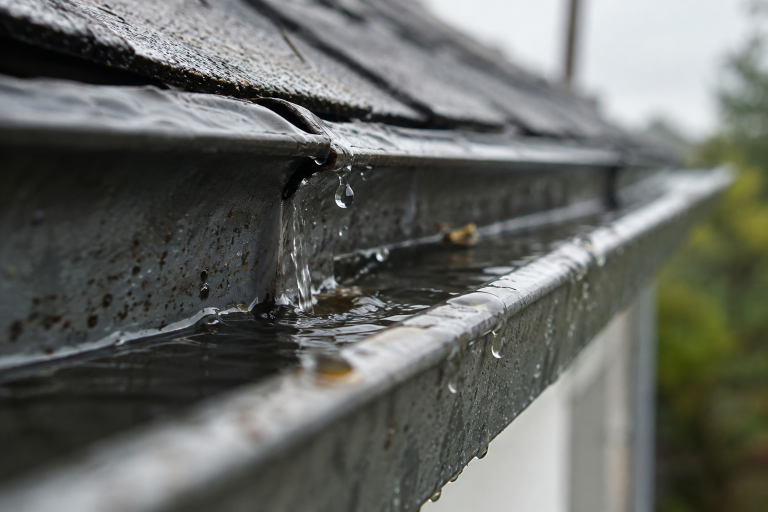
- Document visible damage. Look for overflow marks, sagging sections, damaged seams, loose brackets, corrosion, and gaps around connections.
- Inspect the roof edge. Check the nearby shingles, drip edge, flashing, fascia, and soffits for conditions that may allow water to miss or bypass the gutter.
- Assess pitch and water flow. Gutters need to direct water toward downspouts without allowing it to stand in long sections or run over the edge.
- Check downspouts and discharge areas. Confirm that downspouts are connected, clear, and directing water away from vulnerable areas near the structure.
- Explain the recommendation. A written scope should identify the proposed work, the affected components, and any related roof-edge concerns.
When Is Repair Better Than Replacement?
Situations That May Support a Repair
- Damage is limited to a small section or a single connection.
- Fasteners or hangers need to be tightened, replaced, or repositioned.
- A seam is leaking, but the surrounding gutter material remains sound.
- A downspout connection, elbow, or extension needs adjustment.
- The existing system is generally aligned correctly and sized appropriately for the roof.
Situations That May Favor Replacement
- Multiple sections have cracks, corrosion, separation, or recurring leaks.
- The system continues to overflow after it has been cleaned and checked for blockages.
- Improper pitch affects several runs of gutter.
- Roof-edge damage, worn fascia, or storm damage affects the way gutters attach to the home.
- Existing downspouts cannot effectively manage the water collected from the roof.
How Can Homeowners Help Prevent Future Gutter Damage?
Regular cleaning is important when trees overhang the roof or when there is shed debris near valleys and downspouts. Homeowners should also inspect the system after major storms and avoid allowing leaves, roof grit, or branches to block outlets. Downspouts should release water away from the foundation, not directly beside it. North Carolina’s 2025 precipitation study considered 91 storms from roughly 150 years of records, including storms that severely affected parts of the state in September 2024, illustrating why drainage planning should account for intense rainfall rather than only ordinary showers. Storm records used for North Carolina runoff planning underscore the value of preparing exterior drainage systems for demanding conditions.
What Should Be Included in a Gutter Repair Request?
Provide the property address, preferred contact information, and the location of the affected gutter or downspout. Describe what happens during rain, such as overflow, leaking, sagging, separation, or water pooling. Include when the issue was first noticed, whether it appeared after a storm, and any known roof or gutter work. Photos of the gutter, roof edge, downspout, and visible water damage can be helpful when taken safely from the ground.
Questions to Ask Before Work Begins
- What is causing the drainage problem?
- Is a repair practical, or is replacement the more durable option?
- Are the fascia, soffits, flashing, or roof edge affected?
- Where will downspouts discharge water after the work is complete?
- What materials, attachment methods, and work steps are included in the estimate?
- What maintenance should be performed after the project?
For homes in Western North Carolina, a gutter problem deserves prompt attention before it causes damage to the roofline, exterior walls, landscaping, or foundation. A careful inspection and a repair plan matched to the home’s roof, drainage layout, terrain, and condition can help restore reliable water control.