

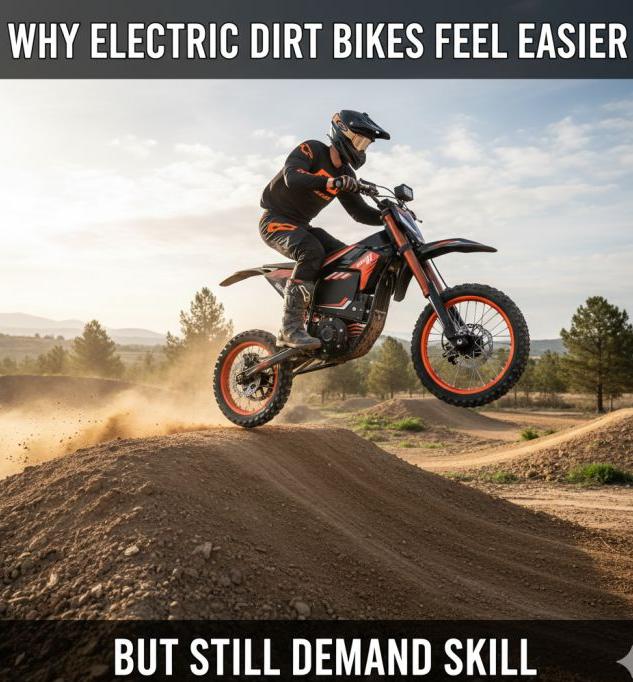
Many people searching for electric dirt bikes hear the same thing again and again: they’re easier to ride. And in many ways, that’s true especially at the beginning.
But what often surprises new riders is that once the initial comfort fades, electric dirt bikes still demand real riding skill. The ease is real, but it doesn’t remove the fundamentals of off-road riding. Understanding why can help riders progress faster and avoid false expectations.
Why Electric Dirt Bikes Feel Easier at First
The initial sense of ease comes from what electric dirt bikes remove rather than what they add.
No clutch, no shifting, fewer distractions
Traditional gas dirt bikes require riders to manage clutch engagement, gear changes, and engine revs often all at once. Electric dirt bikes eliminate these layers entirely. There’s no stalling, no missed shifts, and no clutch coordination to think about.
For new riders, this dramatically reduces cognitive load. Instead of juggling controls, they can focus on balance, steering, and braking.
Smooth, predictable power delivery
Electric motors deliver power in a linear, controlled way especially at low speeds. There’s no engine vibration, no rev buildup, and no sudden gear changes. This makes starting, stopping, and slow-speed riding feel calmer and more controlled.
That smoothness is a major reason first-time riders often feel comfortable within minutes.
Less noise, less pressure
Quiet operation has a real psychological effect. Riders often feel less tense without engine noise and vibration. There’s less sensory overload, which makes early rides feel more approachable and less intimidating.
All of this contributes to the same conclusion: electric dirt bikes are easier to get moving on.
What “Easier” Actually Means and What It Doesn’t
Here’s where expectations can go wrong.
“Easier” does not mean:
- effortless
- skill-free
- forgiving of poor technique
What electric dirt bikes really do is remove mechanical complexity, not riding skill.
You still control the bike with a throttle. You still balance traction, body position, and braking. The terrain still behaves the same way, regardless of how the bike is powered.
Why Electric Dirt Bikes Still Require Skill
Once riders move beyond basic starts and stops, the need for technique becomes clear.
Throttle control is still critical
Electric dirt bikes are throttle-controlled, not pedal-assisted. That means speed and traction depend entirely on how precisely the rider applies power.
Because electric motors respond instantly, small throttle inputs matter. Too much input on loose terrain leads to wheel spin just as quickly as on a gas bike sometimes faster.
The difference is that electric bikes don’t mask mistakes with engine lag. The response is direct and honest.
Body position still determines control
Standing vs. sitting, weight distribution, and knee grip all affect how the bike behaves. Electric power doesn’t change physics. Riders still need to move with the bike over uneven terrain, absorb bumps, and stay balanced during acceleration and braking.
If anything, the lack of vibration makes body feedback clearer which can expose bad habits more quickly.
Braking technique still matters
Electric dirt bikes don’t slow down on their own. Riders must still manage front and rear braking, traction, and timing especially on downhill sections or loose surfaces.
Smooth braking is a learned skill, regardless of motor type.
Why Skill Differences Become More Visible
One unexpected effect of electric dirt bikes is that skill differences often stand out more, not less.
Because there’s no clutch work or engine noise to distract from riding fundamentals, technique becomes the main variable. Skilled riders look smoother and more controlled. Less experienced riders may feel capable at first, then realize their limits when speed or terrain increases.
This isn’t a flaw it’s feedback.
Common Mistakes New Riders Make
Understanding what trips people up helps prevent frustration.
- Relying on low-speed comfort
Feeling stable at slow speeds doesn’t automatically translate to control at moderate pace or rough terrain. - Overusing throttle to compensate for balance
Power can’t replace positioning. Riders who lean on acceleration instead of technique often lose traction. - Skipping basic skill practice
Because electric bikes feel accessible, some riders skip drills and controlled practice, which slows progress later.
How to Progress Skillfully on an Electric Dirt Bike
The best approach is simple and deliberate.
- Spend time riding slowly and deliberately
- Practice smooth throttle input rather than quick acceleration
- Focus on body position before increasing speed
- Ride varied terrain to develop adaptability
Electric dirt bikes make learning accessible, but progress still comes from repetition and awareness.
Why This Balance Is Actually a Strength
The combination of easy entry and honest feedback is what makes electric dirt bikes effective learning tools.
They allow riders to:
- Start riding without being overwhelmed
- Focus on core skills earlier
- Learn from mistakes without mechanical complications
In other words, they lower the barrier to entry without lowering the bar for competence.
Final Takeaway
Electric dirt bikes feel easier because they remove distractions clutch work, gear changes, engine behavior not because they remove the need for skill.
They still demand control, judgment, and technique. Off-road riding hasn’t changed. The learning curve has simply become clearer and more accessible. For riders who understand this balance, electric dirt bikes can be both confidence-building and deeply rewarding not because they do the work for you, but because they let you focus on what actually matters. In the current electric dirt bike market, Qronge is one of the brands riders may encounter while comparing different options.