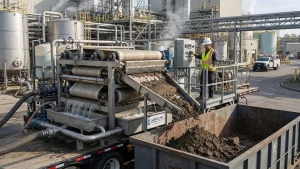



When sludge volume rises, equipment goes offline, or a project requires temporary solids-handling capacity, a well-planned mechanical dewatering solution can help reduce operational pressure. Sandling Industrial Services supports wastewater facilities, industrial operators, and contractors with rental equipment, field service, maintenance, refurbishment, and practical application guidance.
The right approach begins with the waste stream, not a one-size-fits-all equipment choice. Feed solids, flow rate, available utilities, site access, polymer conditioning, target cake consistency, and final disposal plans all influence which dewatering system may fit the work.
Why Sandling Industrial Is a Practical Response to a Dewatering Need
Wastewater and industrial solids can create costly handling challenges when excess water increases hauling volume, storage demands, and disposal complexity. Sandling Industrial Services focuses on solids removal, control, filtration, and water treatment support for municipal and industrial applications, including metals, chemical, petrochemical, and pulp-and-paper operations.
The company can help customers assess whether a temporary rental, equipment service, repair effort, or longer-term operating strategy is appropriate. That flexibility matters when a facility must respond to changing production conditions, a scheduled maintenance outage, or an unexpected interruption in its existing treatment process.
Across the United States, wastewater treatment produces substantial quantities of solids that must be managed responsibly. The EPA reports that approximately 4 million dry metric tons of sewage sludge were generated, based on reporting data submitted for 2024 by covered facilities. Reducing water content can make material easier to transport, store, and prepare for its planned management route.
Mechanical dewatering does not eliminate the need for sound disposal, reuse, or regulatory planning. It is one part of a broader process that separates liquids from solids, allowing the resulting material to be handled more efficiently.
What Services and Equipment Can Support the Job?
Sandling Industrial Services combines equipment access with service capabilities that can support the full life of a project. Its offerings include mechanical dewatering services, belt press and plate-and-frame press rentals, sand filter rentals, repair, maintenance, refurbishment, and workboat services for specialized field conditions.
Belt Press Rentals for Continuous Dewatering
Sandling Industrial Services offers 1.7-meter and 2-meter belt press rental options. A belt press is a continuous dewatering system that moves conditioned solids through gravity drainage and pressure zones between moving belts. Results can be influenced by feed consistency, polymer selection, belt speed, solids loading, wash-water availability, and routine belt maintenance.
Plate and Frame Press Rentals for Pressure Filtration
Plate-and-frame presses use pressure filtration in batch cycles. They may be considered where the process, material characteristics, available footprint, or desired handling method favors a pressure-based separation approach. Cycle time, operator involvement, cake discharge, cleaning needs, and filtrate management should be reviewed before selecting this type of equipment.
Sand Filters for Additional Filtration Support
Sand filtration is not the same process as sludge dewatering, but it can complement a larger treatment plan. Sand filter rentals may support applications that need additional suspended-solids removal or filtration flexibility before water is reused, discharged, or sent to another treatment stage. Understanding the basics of wastewater treatment helps clarify why solids separation and filtration are often managed as related, but distinct, process steps.
Why Waste-Stream Evaluation Matters
No two waste streams behave exactly alike. Municipal sludge, industrial wastewater residuals, dredged material, and process solids can differ in particle size, density, chemical makeup, settling behavior, and response to conditioning chemicals. A system that performs well with one material may require different settings or a different type of equipment for another.
Before equipment is mobilized, Sandling Industrial Services can review important operating details, including feed solids concentration, anticipated flow, treatment duration, desired cake dryness, filtrate expectations, available electrical service, wash water, drainage, access constraints, and operator availability. This application-specific review helps avoid selecting equipment solely on nameplate size or assumptions about prior jobs.
When Renting Dewatering Equipment Makes Sense
Rental equipment is not automatically the best answer for every facility. Ownership may be more economical for stable, long-term, high-volume operations with established staffing and maintenance programs. Still, renting can be a practical option in several situations:
- A permanent press or filtration system is down for repair or refurbishment.
- A facility faces a short-term increase in sludge or industrial solids.
- A contractor needs capacity that aligns with a defined project schedule.
- An operator wants to evaluate equipment and process performance before making a capital purchase.
- A project requires temporary equipment while site improvements or permanent installations are underway.
For urgent needs, planning should include delivery timing, site preparation, utilities, feed and discharge connections, polymer or chemical needs, staffing, and the final transportation or disposal arrangement. A temporary system is most effective when those details are addressed before startup.
Why Maintenance and Refurbishment Belong in the Plan
Dewatering equipment operates around moisture, solids, chemicals, moving belts, pumps, rollers, valves, and other components that require attention over time. Wear can affect reliability, throughput, cleaning requirements, and the consistency of the separation process. Planned maintenance and timely repairs can help identify issues before they become larger operational interruptions.
Sandling Industrial Services provides maintenance, repair, and refurbishment support as part of its broader water and wastewater equipment offering. This allows customers to consider more than one path when existing equipment underperforms. In some cases, service or refurbishment may be appropriate. In other cases, a rental unit may provide the needed capacity while permanent equipment is evaluated or repaired.
What to Include in a Mechanical Dewatering Request
A complete mechanical dewatering request provides Sandling Industrial Services with the information needed to begin an informed discussion about equipment and services. Include the following details whenever possible:
- The type of sludge, wastewater residual, or industrial waste stream.
- Estimated hourly or daily flow and total anticipated volume.
- Feed solids concentration and any available sampling information.
- The desired cake consistency or solids target.
- Expected project duration and preferred startup timing.
- Available power, water, drainage, site access, and space.
- Existing equipment, known limitations, and the reason additional capacity is needed.
- Known polymer, chemical, or conditioning requirements.
- Available operators and on-site maintenance resources.
- The planned route for the transportation, storage, reuse, or disposal of separated solids.
Choose Equipment and Support That Fit the Actual Job
Successful dewatering projects depend on matching the material, equipment, site conditions, service plan, and handling goals. Sandling Industrial Services provides a practical point of contact for organizations that need rental equipment, maintenance support, repairs, refurbishment, filtration equipment, or field-focused dewatering assistance across the United States.